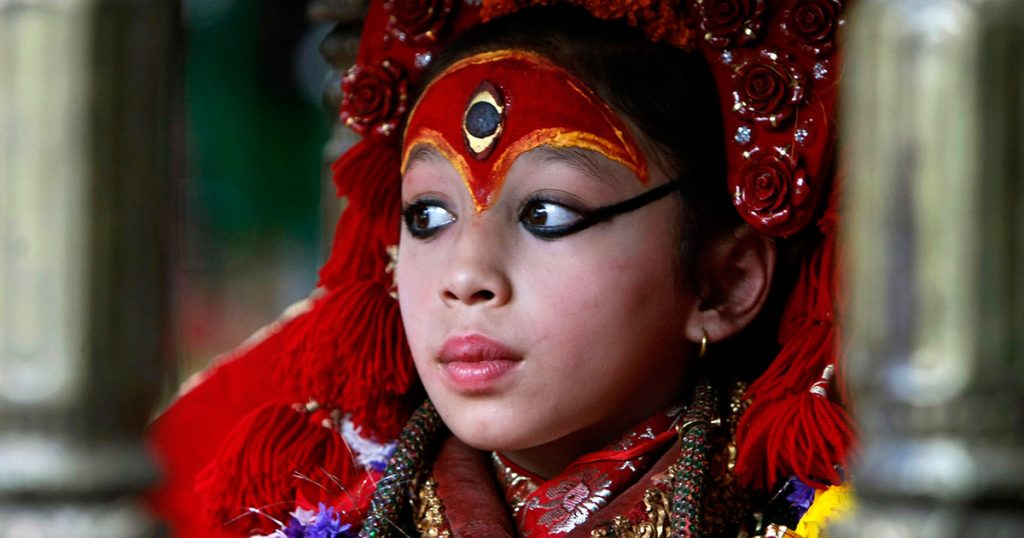
Imagine a girl whose eyes, outlined with black Kajal, vermilion tika on her forehead glows against her flawless skin, dressed in vibrant red and crowned with gold and jewels, whose serene gaze makes the crowd believe they stand before the divine power itself. She is no ordinary child but the Kumari – the living goddess of Nepal who is believed to be the incarnation of goddess Taleju and regarded as manifestations of the divine female energy in Hindu religion. The word kumari originates from the Sanskrit word “Kaumarya” which means “virgin” referring to the culture of worshiping the virgins.
The royal Kumari of Kathmandu steps out of her palace only on special ceremonial occasions and traditionally, she makes public appearances 13 times a year like Navaratri or Indrajatra Festival. She is worshiped until she suffers some kind of injury, illness or until her first period. The tradition of worshiping started during the regime of Jaya Prakash Malla who advised his men to construct Kumari house which is located in the Basantapur area. It is a storehouse of magnificent carvings where Kumari performs her daily rituals. But the kumari’s time interval of staying in the Kumari house ends with her first menstruation. The tradition preserved by the Newar community still reflects the culture and history of Nepal and Newars.
Story behind the tradition of Kumari in Nepal
There are many stories and myths behind the tradition of Kumari in Nepal. The most popular legend behind the tradition goes like this:
Goddess Taleju and the King: In ancient times, Goddess Taleju used to visit the royal palace of the Malla kings of Kathmandu every night to play a game of dice and advise the king. One night, the king made a romantic or disrespectful advance that made the goddess angry. She stopped visiting the palace and declared that she would only return in the body of a young virgin girl from the Shakya caste (a Buddhist Newar clan). The king, repentant, began the tradition of selecting a girl to embody Taleju — thus, the Kumari tradition began.
Some main qualities to become Kumari
The Kumari- living goddess of Nepal, is not just any child. Her selection follows centuries old sacred tradition rooted in both Hindu and Buddhist beliefs. The young girl is chosen from the Newar Shakya or Bajracharya community and she must embody specific physical, spiritual and astrological qualities, far beyond that of an ordinary girl. Some of the main other qualities are :
- Kumari’s horoscope should match with the horoscope of the king
- The physical requirements are black eyes, hair, and eyelashes like a cow
- Must meet all 32 human qualities
- Some other requirements are twenty unbroken teeth and body like a banyan tree
- Girl should be a virgin without any defects
Interesting Fact about Kumari
In Nepal, there are not just one Kumari- although the Royal Kumari of Kathmandu is the main and famous, several Newari towns and cities of the Kathmandu Valley also have their own Living Goddess traditions. These Kumaris are worshipped locally and participate in their respective festivals and have great importance in their local community. There are at least nine main kumaris recognized in the Kathmandu valley and nearby Newari towns: Kathmandu, Patan, Bhaktapur , Bungamati, Sankhu, Tokha, Thimi, Panauti and Nuwakot.
Have you ever imagined witnessing the Living Goddess Kumari, whose every glance is believed to bless the city with divine protection ?